Wednesday, April 27, 2022

Who is responsible for the fate of our Earth?

This is one of the last APs for our Senior year STEAM class! This class is called Frontiers, and we spent our first unit learning about Ocean exploration, anatomy, the climate, and our future as a planet. We learned key terms like Geo-engineering, Ocean Acidification, Oceanic Zones, and any other aspects of ocean life, functioning, and how humans impact our oceans and climate. We watched a documentary featuring Jacques Cousteau - a renowned Ocean explorer and climate activist. We learned about his contributions to our knowledge of the Ocean and its inhabitants, and also our global progress in climate change awareness. We also had an FE where we visited Urban Rivers. There, we got to experience first hand the work they are doing to re-instate river banks, via floating plants structures. It is a part of their 'Wild Mile' project. We learned a lot this unit. For this project, we were challenged to use our knowledge of the Oceans and push it forward. We were to come up with a question, summarizing specific research we would like to conduct, which included both secondary and primary sources. For my research, I was interested in finding whether or not individual actions really make an impact on the climate. I also sought out to find if it is only up to individuals, or if there are other parties that play significant roles, as well. You can see my 3 page paper, below. Enjoy!


Who is responsible for the fate of our Earth? 

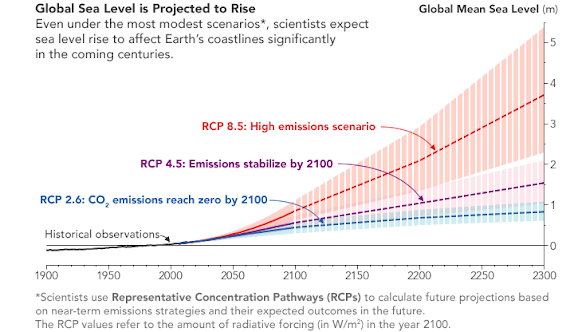
            From young ages, we are taught the three R’s; Reduce, Reuse, and Recycle. We are told that these three things can save the world, if everyone were to do them. However, can and should the fate of the climate and the human race, really be left in the hands of the individual? Or does the responsibility fall on someone bigger? According to NEEF, the global temperature has risen almost 2 degrees Fahrenheit since the early 1900s and the sea level has risen almost 10 inches and shall continue to rise at staggering rates (see graphs below). This can be drawn back to many things but a main reason is the rise in the human industrial impact and our usage of Fossil Fuels. The damage seems to have been primarily done by major corporations but they don’t seem to want to take responsibility. In recent years, there has been an enormous call for action and it looks like, for right now, the responsibility to fix these mistakes has been placed on individuals. Simple solutions have been proposed like the three R’s, but are these enough to reverse the damages? Do individual behaviors really make an impact on the climate? 


Global Surface Warming

Global Sea Level Rising


             To begin to find the answer to these questions, a synthesis matrix was used to organize a list of 5 secondary sources and 5 supporting ideas to my research. The first topic of research was to find a more in-depth list of ‘at-home’ climate solutions, than just the typical three R’s. NOAA had the most detail and they suggested composting (overall limiting of waste), Reduce - Reuse - Recycle, biking more - driving less, educate, volunteer, conserve water, choose sustainable food, shop wisely, conserve electricity, garden (plant trees), and reduce use of harmful chemicals. 

            After finding these, the next topic of research was to find the ‘true impact’ of these solutions, and to see if they really are as effective as they seem. Block Club Chicago explained how the city of Chicago’s recycling rate is low at 8.8%, compared to other major cities like San Francisco and Seattle who’s recycling rate is at 60-80%. So, if recycling is your main choice of impact (and you live in Chicago), it really wouldn’t make much of a positive environmental difference. The effectiveness of certain solutions clearly depends on your geographic location and external research. 

            The next piece of the puzzle was answering the question, should the fate of the climate be left in the hands of the individual or someone bigger? Upon looking at a couple of sources, the conclusion came to be that it is neither the responsibility of one or the other (individuals or corporations/policy makers), but both. Again, from NOAA, they say that, “Protecting our planet starts with you”, however, it can’t just end there. From the Sierra club, they state, “Yes, actually, individual responsibility is essential to solving the climate crisis … but the environmental movement needs to sustain a way to do both: agitate and organize for systemic change while also still encouraging individual behavior changes.” And lastly, from WEF, they say that, “Without the support of policymakers, businesses and other organizations, the transition [into the future] may not happen quickly enough to stay under the 1.5° Paris global warming target."

            Finally, where do we go from here and how do we transition into the future? The answer is the continuation of individual, corporate, and policy responsibility, as well as renewable energy. Solar, Wind, and hydro power could reframe our future, and it is very possible. WEF states that 100% clean renewable wind, water, and solar power should be implemented no later than 2050, and at least 80% should be implemented by 2030. Cities will also be transformed into ‘super grids’ and we will no longer use Fossil Fuels. 

            In Addition to the secondary research, there was also primary research that was conducted. In order to get individual perspective, a survey was sent out, asking everybody a series of questions. The questions were: 

1. What, in your opinion, is the most pressing matter in regards to the climate and the preservation of the Earth? 
2. Have you ever heard the phrase, “Reduce, Reuse, Recycle?” 
3. If you have, have you ever tried to implement it into your daily life? 
4. How did that go? How effective or practical was/is it? 
5. Are there any other simple climate solutions that you have heard of? 
6. How effective do you feel like those are - are they influential enough, do they actually work, do you think people are moved to abide by them? 
7. What do you feel is the best way to spread knowledge about climate change? 
8. Do you think these simple solutions are enough - especially if everybody implemented them -, or are there more powerful decisions that need to be made? Explain. 
            
            There were a lot more responses than anticipated, however, most people had the same or similar responses. 
            
            Many people’s first concern relating to the Earth was Global warming - related also to sea level and temperature rise, Ocean preservation, and our heavy reliance on Fossil Fuels. When asked if they had heard of the phrase, “Reduce, Reuse, Recycle”, 16/16 responders said ‘yes’. The typical answer for if they had ever implemented this into their daily life, was a lot of agreement that they tried to but it was either too hard to keep up with or they felt like it didn’t really make enough of a difference. 
            
            There were also many other ‘simple’ solutions that people listed that were not explicitly mentioned in the secondary research; these included turning off the lights, not having children, shopping locally instead of online, ‘unplugging’ for a bit, using reusable products, investing in greener homes, transitioning into walkable cities, putting pressure on corporations and policy makers and, “uh use more nuclear fuel but don't let it go boom cause that's bad”. When asked if they felt like those solutions were influential enough to actually work, the main response was, “Not enough people feel the urgency”. This leads into the many ways that we need to spread education and the urgency to the mass population, some of them being media, advertisements, TV, News, and exposés. 

            The last responses that were given were the conclusions on who should take responsibility for climate change. Two responses that were similar and basically summarized everyone else’s statements were: “I think if everyone took part in these solutions, while it wouldn’t fix the problem, it would heavily cut down its growth - I think bigger measures are needed to be able to completely fix the planet,” and, “Both need to happen. People need to do small practices, and there are big legal decisions that also need to be made. For example, not burning as much oil.” 

            In conclusion, it is neither just individual or corporate responsibility, but both. The whole population as a collective needs to come together to move us forward, into a sustainable future. So, simply put, the future of the climate and the planet rests in everybody’s hands, since everybody living on this earth is affected by the consequences of not taking care of it. Lastly, this research connects to SDG 14 because it shows who needs to take responsibility and who the responsibility has been currently placed on. It shows how most individuals are willing to do something for our ocean, climate, and species conservation - now it is time for those in power to do the same. 


Sources 


US Department of Commerce, National Oceanic and Atmospheric Administration. “What Can I Do to Protect Coral Reefs?” NOAA's National Ocean Service, 10 Aug. 2009, https://oceanservice.noaa.gov/ocean/earthday.html. 

Bauer, Kelly. “Chicago Recycling Rate Gets Even Worse at 8.8%. New Laws, More Composting Could Change That, Report Says.” Block Club Chicago, Block Club Chicago, 15 Nov. 2019, https://blockclubchicago.org/2019/11/15/chicago-had-a-recycling-rate-of-just-8-8-last-year-new-laws-more-composting-could-change-that-report-says/. 

“Yes, Actually, Individual Responsibility Is Essential to Solving the Climate Crisis.” Sierra Club, 4 Dec. 2019, https://www.sierraclub.org/sierra/yes-actually-individual-responsibility-essential-solving-climate-crisis. 

Written by Johnny Wood, Senior Writer. “Renewable Energy Could Power the World by 2050. Here's What That Future Might Look Like.” World Economic Forum, https://www.weforum.org/agenda/2020/02/renewable-energy-future-carbon-emissions/. 

“Goal 14 | Department of Economic and Social Affairs.” United Nations, United Nations, https://sdgs.un.org/goals/goal14.


Blog Conclusion

Overall, I enjoyed this project. I like all of the research I conducted, especially making and sending out a survey to people - I felt so official. I think I did well organizing my findings, though this project did take me a while. I was very interested in the topics of the Ocean, and it still fascinates me how little we really know about the Ocean. 

Friday, April 1, 2022

Thursday, March 10, 2022

Taxes in 2122

This is the last AP for our Humanities class, Equality. In this unit, Hxstory, we further dived into the topics of Race, Gender, and Class, except this time, we focused more on the present-day relations of each category and acknowledged how history got us to each of these points. In this unit, we discussed the value of learning accurate history, systemic racism, critical race theory, feminism (how it started and how it's defined now), social class and poverty, income inequality, and the current race, gender, and class relations in the U.S. We watched a couple of Trevor Noah videos on history and CRT, we listened to Talking while Black, talking about a recent racist incident at a high school, we read Bad Feminist, talking about how Feminism is now defined and misunderstood, we watched Roger and Me, which centered around GM factories closing in Flint, and we ended with a couple of crash course videos on Social Class. My favorite part about this unit was learning about the current class status and inequalities in the country because I feel like it says a lot about our society and it also draws race and gender into it. After going in-depth about all of these topics, and learning about how history gets us to where we are and carries us into the future, we were challenged with our project. For this project, we chose a specific event or occurrence that we thought would happen in the next 100 years (by 2122). It could be any prediction of a policy change or status of a certain movement from today (2022) and were to create a 'news' segment on it. For my topic, I chose to imagine the status of the Tax the Rich movement and if there had been any progress. I report on a new piece of legislation that was passed, called the Equitable Tax Act, which focuses on the upper, middle, and lower class each paying their share in taxes. Below, you will see my video and script. Enjoy!


Script

March 3rd 2122 

Intro 

Good morning, daily viewers … Today is a very significant day. The date is March 3rd, 2122 … Taxes are due in April. It couldn't be a more perfect time for the Equitably Taxed Act to be passed. After a lengthy 100 years of the Tax the Rich movement, and the near destruction of the lower and middle class, long-awaited action has finally been produced and Axolotl Musk, who you may know, was the first to experience it. 

Body 

Before I quote Axe, let me first give a little context on the legislation, and what we had to go through to get it. Tax the Rich has been a movement for over 100 years. It started, as it says on taxmarch.org, as, “a movement, a rallying cry, and a way of thinking. It's about fixing a fundamentally broken and rigged economy so that it works for all of us…” And then goes on to further explain the history and status of the current economy (a hundred years ago), and so on. Anyways, so throughout this last century or so, there were marches, riots, proposed bills, and countless efforts made by leaders or public figures that were a part of the movement, to introduce and pass actual legislation. And after years and years of trying and trying again and again, an Act finally went through. The Equitably Taxed Act federally ensures that people are taxed based on their income, instead of a fixed percentage, and there is to be more education about taxes, and therefore, fewer loopholes that the upper class primarily is able to take advantage of. The problem that this is going to solve is that in the past, technically the low income and higher-income people were being taxed ‘equally’, however, when you look at the bigger picture … you can see the vast differences in how much each class was paying and how it affected them, separately. To put it into perspective, imagine an upper-class individual, who makes $200,000 a year, and a lower-class individual, who makes $25,000 a year, both have to pay $700 in taxes. While that amount is equal, the effects on either one are heavily unequal. The $700 in the upper-class person’s wallet is barely a dent, but for the lower class individual, that could be almost a full month’s salary. With this new Act, each class will be taxed a percentage based on their income, so no one person pays more than the other - they just pay what they can based on how much they make. A lot of other fundamentals of the Act were also inspired by Axe’s contributions to her grandfather’s business … which I’ll mention shortly. 

The granddaughter of Elon Musk, a renowned billionaire who has found his new home on Mars, was the first to see this act go through. She filed her taxes on March 1st, and she noted that she happily paid significantly more than she had the year before. She then said, “I think my grandfather would be proud if he were still down here - I am thrilled to be a part of such progress and hopefully this will do enough to restructure the lower and middle class. I think it is time that we widely hold the upper class accountable and start to rebuild our nation and economy, hand-in-hand.” 

As you know, Axolotl Musk is a member of the upper class herself, being an heiress to her grandfather’s empire and all, but from a very young age, she has familiarized herself with the suffering of the lower classes in the country. She has been an influential leader in the Tax the Rich movement, and an active participant in her grandfather’s empire - especially dealing with funds. She has always pushed for the money made in the business to be primarily redistributed externally. She created new jobs and opportunities, supported environmental organizations, and donated whatever she could. After all of her hard work and success with the business, congress decided to make these key elements part of the Act as well - there is now the promise of new jobs, environmental stability, and better usage of gov. funds. I think it is safe to say that she is a very crucial figure to the movement and to the passing of this Act. Those who are in favor of it are very happy for her to be one of the leading faces and I am extremely enthusiastic to move on into our future, following this event. I can’t wait to report further on what is yet to come and see our country’s economy be rebuilt and for the American people to feel united and supported. 

End

Well, we’ll see you tomorrow … bright and early at 9am! Start your day Chicago…. Peace out. 


Conclusion 

I hope you enjoyed the small news segment! Overall, I really enjoyed doing this project. I thought it was fun imagining what might happen in the future because it could really be anything I made it to be. It was a little hard to write out the script at first and for me to figure out how to structure the video, but all in all, I am pretty happy about how it all turned out. If I were to do something different, I would have probably added more visuals and pop-up graphics to make it slightly more engaging. However, I am proud of my work and would love to do something like this again. 

Works Cited

“It's Time to Tax the Rich.” Join Us in Asking for a Real Debate on Taxes., 1 Mar. 2022, https://taxmarch.org/.

Can you have a conversation with a computer?

This is our last project for our Coding workshop. In this unit, we really focused on if, elif, and else statements. Through this, we learned how to further give the computer more in-depth instructions. We also learned about Booleans, which are a part of if/elif/else statements and they can be true/false, less/greater than or equal to, etc. They are essential to setting up the result of the rest of the statement. The last thing we learned was (#)comments, and they are basically just notes that you can leave yourself in the code, that the computer won't read. For this project, we were challenged with making code that allowed us to have some sort of 'conversation' with the computer - like a chatbot. Below, you will be able to interact and answer questions, using my code. Enjoy!


I hope you enjoyed that mini conversation! Overall, I really enjoyed making this project. Usually, it takes me a while to construct these but once I had an idea it was just smooth sailing from there. I feel like I've really come to understand and have fun with code and I would love to do something like this again. If I had more time, I might've made the conversation a little longer, but I am happy with how it turned out. Thank you for interacting with my project!

Monday, February 28, 2022

Mega-Thrift

This is our AP for our 2nd unit of Social Entrepreneurship. We covered a lot in the duration of this unit since it spanned over a period of 5ish weeks. We learned a lot about what it means for a business to be a Social Enterprise - some of the main themes were serving the public and working to solve a common social issue. We did a lot of exploration of mission and vision statements, business structures, marketing strategies, and what makes a business successful. We also looked at multiple social enterprises and analyzed their structures and mission/vision statements to see how they were operating. We had multiple guests - some of them being Sharon Cho, Felicia Winiecki, Ian Mackey, the Allstars program, and we also visited UChicago's NSP. Overall, we gained very helpful insight as we lead into creating our own business idea. After indicating a social issue we wanted to solve, we went on to create logos, brainstorm legal structures, business models, our business purpose, and how we would work to improve the future. Below, you will see my business, enjoy!

Mega-Thrift 

MEM. Mega-Thrift Logo. 2022

Context 

For the past couple of years, I have been pretty passionate about the current issues surrounding the well-being of our planet and specifically, how wasteful our country is. In one year (2018), the U.S. produced 292.4 million tons of solid waste and I think that is a direct consequence of there not being a designated place to send some of this waste, other than a landfill. I experience this myself where I throw away products that were not all the way used because I moved on to new ones, or I throw away food because it sat in my fridge until it expired, or I give away clothes that I never wore, etc. But as I discard these items, I never stop to think about where they go, and even if I do donate some of them, I can never be sure if they will be rebought or if they will just continue to collect in a facility, similar to if it were in a landfill. 

Along with the amount of waste in the world, there is also the growing issue of individuals who live in poverty or who are homeless in this country. There is also the concern of affordability of products that I consider to be basic needs - quality clothing, food, and hygiene/sanitary products. In 2018, 29% of the population was considered lower-class, in 2019, 13.4% of the population was below the poverty line, and in 2021, 0.2% of the population was homeless. Many lower-income communities also live in areas where the local supermarket, convenience store, or clothing store, could be miles away. They don't have money for a car, and there is often no constant form of public transport. So, how do these people get their food, clothes, and hygiene products? 

Oh so conveniently, there are many fast-food places that find their way into these communities, and since they are cheaper options, many people are forced to eat there. There has also been a rise in Fast Fashion and online stores like Shein, which produce clothing at a heavily cheaper cost than main fashion brands. Even though these items may cost less, they come with a much higher moral price. Brands like these are able to price clothing so low because they operate in countries where the labor laws are much looser, and they can get away with paying workers little to no wages, and they overwork adults, as well as children. They also have huge environmental impacts because of factory emissions and textile waste. This also leads to product production. A lot of cheaper options for makeup, shower products, personal hygiene items, etc are made with toxic chemicals and they also often test on animals. Unfortunately, the companies that produce more sustainably are smaller, so in order to stay afloat, they have to price their items higher. Consumers with less money are forced to continue to buy the more toxic options, and the 'clean' sustainable option is considered a luxury. It is strange that in this society, taking care of yourself, getting proper care, and having access to nontoxic food, products, and clothing are considered a luxury instead of something everyone is able to have. 

Collecting this data was important in assessing the reason for my Social Enterprise and how it could possibly work to respond to this issue. While my idea can't necessarily solve poverty, hopefully, it can work to make it easier for those who fall into that category. 

My business

My business is called Mega-Thrift. Similar to Goodwill, it is a place where anyone who is able can come and donate items they no longer find a use for. However, I wanted to think bigger than just clothes and home goods. People at Mega-Thrift can come and donate clothes/seasonal-wear/accessories they no longer want, food that is just collecting dust in their fridges or cabinets, and any toiletry/sanitary/hygiene products that they may have extra of. The only requirement is that anything that someone brings should be in the condition to pass onto someone else. Meaning, the things you are prepared to donate should be in like-new or good condition - preferably not heavily used. It is a place where homeless and low-income families can come to get whatever they need (within moderation), completely free of cost. My overall goal is to save the planet from harmful and unnecessary waste and especially to give people the chance to access basic needs, that they wouldn't otherwise have. Another main goal is for this to be open to everybody. I don't want it to be exclusive, and the business puts trust into recipients to be people of actual need and that people would not take advantage of taking free products from those who really needed them. 

Along with clothing, products, and packaged food, Mega-Thrift also offers free showers, dressing rooms, and places to cook your food and come and sit for a while. Though spaces are limited, there are jobs (primarily for homeless people) and support offered to give them the opportunity to get back on their feet. Mega-Thrift is a non-profit so it survives based on people's generosity and donations, along with government funding. It also primarily relies on volunteers but there are employees as well - their salary is also provided by government funding. 

Day-to-Day specifics

In terms of schedule, the day would start at 8 am and end at 8 pm. The facility would be opened and prepped by employees, getting the space cleaned up from the day before - showers stocked with towels and products, dressing rooms cleared out, eating and cooking area fixed up and sanitized, donation bins emptied and everything is taken to be displayed, etc. Once that is all done, the doors are opened and people can come in and out at their leisure. Donations are accepted for the duration of the day and volunteers can sign up for shifts from 9am-7pm but they can only work for a max of 4-hours at a time. Upon arrival, folks can stop by at the front desk and receive a 'proof of donation' receipt. They will then move onto the bins where their items will be assessed and placed in their designated bins. If someone's donation is money, they can drop it off at the desk and they will receive a different type of receipt which acts as a tax right-off depending on the donation amount. I hope for this to be a beneficial service to the public and for us to give back to our surrounding community. Along with us giving back, Mega-Thrift also provides the opportunity for others to give back as well. There is a volunteer program that gives college and school credit for students (under 18 requires a parent or adult accompanying them), and just an overall feel-good sense of achievement to anyone who signs up to help. 

Future

For right now, Mega-Thrift is just going to be located in the loop of Chicago, but in the future, I hope to expand Nationwide and further eradicate these problems across the country. I hope to make the most out of my Social Enterprise and that it will be received well and actually succeed in its purpose. Additionally, I hope to eventually make the business double as a community center and a shelter. 

Social-Media post

An effective strategy for marketing these days is Social Media. Below you will see an example of an Instagram Ad for Mega-Thrift and its Mission and Vision statement, Business model, and Real Tangible Change.


I hope you enjoyed learning about my business idea. All in all, I really enjoyed spending time brainstorming my business idea, especially because I am passionate about solving these issues. It was a little difficult to figure out some logistics, especially because I didn't realize how much detail has to go into creating a new business. I still don't even feel like I've included everything. That is probably something I'd add if I had a little more time - more numbers (stats) and detail about funding and the money management aspect of my business. Overall, I am proud of what I was able to come up with. Thank you for reading! 

Thursday, February 17, 2022

Who knew you could use Code to do math or write a letter?

For unit 2 in our Coding class, we dove into python and worked on two projects centering around the ideas of our Humanities and STEAM classes. For our STEAM class, we were able to make a calculator, focused on any math equation we had had in the past, and for our Humanities class, we formed a letter to someone, by using key input words - it was basically structured like Mad Libs. Below, you will see the behind-the-scenes for the actual code, and then you will be able to try it out!

Behind-the-scenes:
 
Calculator code
Letter code


Project A - STEAM

Project B - Humanities


I hope you enjoyed interacting with my code! Overall, I really enjoyed these projects. There was a little bit of frustration along the way, sometimes as code gets tedious, but once I figured it out it went smoothly. When I know what I'm doing coding can be really fun, and I would definitely do this again. 

Monday, February 14, 2022

What are we prepared for?

This is the first Action Project for our Humanities class, Equality. We covered a lot in this unit, specifically topics on race, sex, gender, and class, and the history of those throughout American society. We also learned about the meaning of the inequalities within these categories and key terms like racism, sexism, and classism. Some other notable things we went over were white privelage, white supremacy, the history of discrimination against people of color in America, feminism, toxic masculinity, disproportionate class inequalities, the trap of the "American dream", and America's obsession with wealth, greed, and consumerism. We had deep discussions about our thoughts, brainstormed ideas, asked questions, and overall, grew on our information and exploration of these topics. 

We also had a couple FEs - one from a border defense lawyer, and the other was a woman who taught us about Zines, which is what we ended up making for this project. On that note, for this project we were challenged with creating our very own Zines, focused around retelling an event or concept from the perspective of or in favor of a marginalized voice's point of view. I chose to talk about the history of gender discrimination in schools, and society's construct of Men and Women's roles. I also wanted to include how trans and non-binary people are treated because there are more than just two gender identifications. Below, you will see a GIF of my physical Zine and then it in a slideshow form. Enjoy!

My Zine:

MEM. Zine GIF. 2022 


I hope you enjoyed looking over my project! I also hope that you might have gained some insight as to how our schooling affects us going into society and the constructs that have been placed on us in the past and still today. Overall, I really did enjoy doing this project. This is a topic that I am passionate about and I liked researching, writing, and the process of creating and physically building the Zine. It was a little challenging to get started on what to write since there is so much to say about this topic, but once I got going, I feel that I made a pretty strong project. If I were to do things differently, I probably would have added more images or more appealing imagery, but all in all, I am happy with how it turned out.