What do the disorders from the DSM-5 teach us about our minds?
That is my guiding question for this Final Project. I have decided to base this project after our most recent project in Disease, where we focused on mental disorders and the DSM-5. For that project, we chose our own disorders to learn about, presented information about them to the class, and finally, created a simulation of that disorder. I chose Delusional Disorder, which is related to Schizophrenia and it is where someone can't differentiate reality from their own imagination. I simulated it by showing the class a video called, The Tucher Zone. You can see more information on what I did with that presentation, farther back on my blog.
For this Final Project, I used the guiding question to look a little bit deeper into the DSM-5 and the significance it has to mental disorders. I put together a slide show where I explain the DSM-5 more in-depth and briefly mention some more information about Delusional Disorder. I made a poster that I used in my previous project but amped it up a bit and added more information about DD. Below you will see my slide show and in that, my exploration of the guiding question. Enjoy!
Wednesday, March 18, 2020

Saturday, March 14, 2020
Don't Ban the Flies
This is the last Action Project for our humanities class, Forbidden Books. For this project, we continued to focus on the banning of books and based this on what we did with our last project, focusing on Dogma. We used the independent reading books that we chose at the beginning of this unit to write a research paper. The criteria for this paper were to choose a side on whether or not our books should be banned and gain a little more context on this concept. I took the side of the book not being banned and you can read my paper below to learn more about the book and why I took that side. The paper was about 3 pages long (not including works cited page), so I put it into a slide show so that it is easier to read. You will see the slide show and an original image I created below. Enjoy!
 |
| MEM. Lord of The Flies Watercolor. 2020 |
Thursday, March 5, 2020
Real or Not Real?
For this AP, everybody in our class was supposed to look through the DSM-V and find a disorder they wanted to focus on for their project. For mine, I chose Delusional Disorder, which is related to Schizophrenia. I chose this because it was what most caught my eye and I've always been interested in learning about Schizophrenia. The medical definition as stated by the Cleveland Clinic is, "Delusional disorder, previously called paranoid disorder, is a type of serious mental illness -- called a 'psychosis' -- in which a person cannot tell what is real from what is imagined. This is unlike people with other psychotic disorders, who also might have delusions as a symptom of their disorder."
If I were to define it in my own words, I would define it as a state in which someone can't differentiate reality from their own imagination; It includes delusions but is different from other disorders because it doesn't contain any other symptoms of psychosis. Three DSM-V criteria for this disorder are, "The presence of one or more delusions for at least a month", "If mood episodes occur concurrently with the delusions, the total duration of these mood episodes is brief relative to the total duration of the delusional periods", and, "The delusions re not attributable to the physiological effects of a medical condition (eg. Alzheimer's disease) and are not better explained by another mental disorder, such as body dysmorphic disorder or obsessive-compulsive disorder" (90). Delusional disorder also affects the right hemisphere of the brain. This is because the right side of the brain dominates self-recognition, emotional familiarity, and ego. An explanation by https://www.eurekalert.org/pub_releases/2009-01/nlmc-daw011309.php states that it, “...may cause delusions by disrupting the relation between the monitoring of psychic, emotional and physical self to people, places, and even body parts.”
For this presentation, I explained a little bit about Delusional disorder and then went straight into showing the class a video (credit to my friend, ES for giving me the idea). The video was called The Tucker Zone and it worked as a simulation for delusions because it plays with your imagination and makes you think that what you see is real or happening right there in the room. When I asked the students how they felt, they mainly talked about how the experience seemed very real and how certain parts were triggering for them. I then created a graph using my lesson plan for the brainwaves of the students during my presentation, along with a piecewise function for that graph. The last thing I did was to create a flyer that gives a summarization of the disorder and provides more context, recommendations of support, etc.
I hope you enjoy my project!
Lesson Plan:
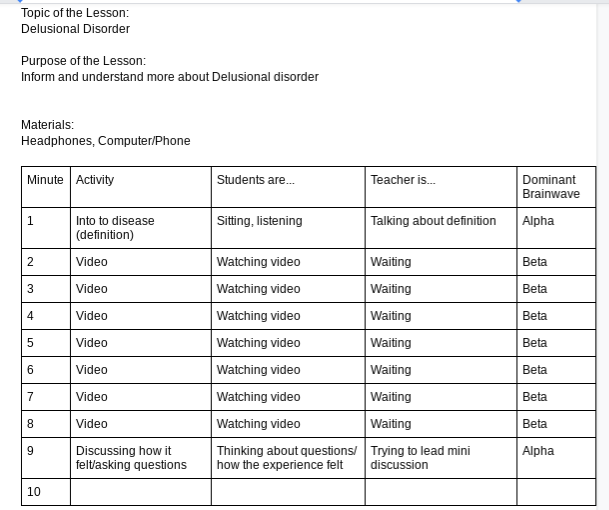 |
| MEM. Lesson Plan. 2020 |
Graph:
 |
| MEM. Brainwaves Graph. 2020 |
Piecewise Function:
y { 0 (x-8) +4 if 2< x ≤ 8
-1 (x-9) +3 if 8< x ≤ 9
Flyer:
 |
| MEM. DD Flyer. 2020 |
Video:
Works Cited:
“Delusional Disorder.” Cleveland Clinic, https://my.clevelandclinic.org/health/diseases/9599-delusional-disorder
DSM-V
https://cdn.website-editor.net/30f11123991548a0af708722d458e476/files/uploaded/DSM%2520V.pdf
Nyulmc. “Delusions Associated with Consistent Pattern of Brain Injury.” EurekAlert!, 13 Jan. 2009, https://www.eurekalert.org/pub_releases/2009-01/nlmc-daw011309.php
The Tucker Zone
https://www.youtube.com/watch?v=3txhT2ncNOU&feature=youtu.be
“Chicago Psychiatrists - Psychiatrist Chicago, Cook County, Illinois - Psychiatric Nurses Chicago, Cook County, Illinois.” Psychology Today, Sussex Publishers, https://www.psychologytoday.com/us/psychiatrists/il/chicago
Saturday, February 29, 2020
Dogma of The Flies
This action project is for unit 2 of our Forbidden Books class. For this unit, we continued our learning of banned/censored books in America. To further gain understanding about censorship, we went on a Field Experience to WBEZ and spoke with Natalie Moore, a journalist who has had a book banned in the Illinois prison system. We also talked about censorship pertaining to religion and its teachings. Along the way of exploring censorship in religion, we took a look at the origins of Christianity and Islam and compared the similarities between them and their standards. We even went on a Field Experience to a mosque so we could have the opportunity to learn more about Islam. As we looked at the origins of those two religions, we also learned about Dogma and how it not only shows up in religious teachings but, everyday life.
For unit 2, our class read The Absolutely True Diary of a Part-Time Indian, by Sherman Alexie. We read this book because it has been banned in American schools for religion, sexual content, and the use of racial slurs. Our class also chose independent reading books that have been banned/censored, to support the theme of this project. I chose Lord of The Flies and it has been banned from schools all over the nation.
For this action project, we were instructed to make a podcast with one of the leading characters and interviewing them about their dogmas. I chose Ralph because he showed really strong leadership qualities and the need for maturity and guidance. His dogmas were trying to get the group of boys to act civilized and follow his rules. Along with believing in following the rules, he also knew that when people are left to their own devices they revert to savagery, and that the leader doesn’t necessarily need to be the strongest person but, the smartest. Below you will see the podcast and the script for the interview, enjoy!
It was 1942 and the world was in the midst of a World War. A group of young boys (ages 6-12) were being evacuated from their homes in England, via airplane. A devastating crash killed all of the adult pilots, leaving the children alone and stranded on an island, somewhere in the Pacific Ocean.
When the boys first gathered together on the island, they had to figure out how to take care of themselves without any adults around (which didn’t go so well). As they tested their freedom, their choices most often reflected their age levels and them satisfying their desires of the moment, without thinking through consequences.
As their imaginations grew larger, so did their “imaginary” fear of a beast on the island. This threw everybody into a larger survival mode and episodes of irrational thinking. As they fought for survival, their choices began to show the lengths they would go to protect themselves, even from each other.
The focus of today’s interview is on the boy’s leader, Ralph. We’re following his story and his experiences he had to endure. This journey begins with us back on the island that Ralph was rescued from so many years ago. We came back to this specific spot so that we were able to get the full experience of Ralph’s triggered memories; Times that were especially difficult to think about.
Opening sounds
(Plane flying and crashing sound effect)
(Fades into seagulls and ocean)
MM: What are you thinking about Ralph?
Ralph: I don’t know … just being back here, it’s bringing up a lot of memories.
MM: Do you think about it often? (pause) (Ralph sighs)
Ralph: I don’t think there’s a day that goes by that it’s not on my mind.
MM: Have you seen any of those boys since you were rescued?
Ralph (laughs a little - sad laugh): No … It was best for us to be apart.
MM: Why is that?
Ralph: It was hard because what we all did, what we turned into - or what others turned into - really caused a lot of trauma for all of us so we decided it was best for us to not see each other to prevent any negative rehashing. I remember saying to my self, “They were savages, it was true, but they were human” ().
MM: Yea, that makes sense.
MM: How did you react when you realized you were stranded and there were no adults on the island?
Ralph: I reacted in the way I think most 12-year-old boys would act at that moment, I was excited. I was with Piggy at the time and I was just ecstatic, running around doing handstands, swimming in the water, and playing in the sand. Normal things a kid would do when they have no one to be scolded by.
MM: What was the process of being chosen as the leader of the group and was there anything going through your mind?
Ralph: The boys chose me because I was the one that most resembled an authority figure. My belief was that we should remain civilized and maintain a decent amount of rules. One day we were all discussing how it was important to keep our fire going to be able to get rescued. I was also trying to set some ground rules and I said, “We’ve got to have special people for looking after the fire. Any day there may be a ship out there … and if we have a signal going they’ll come and take us off. And another thing. We ought to have more rules. Where the conch is, that’s a meeting. The same up here as down there” (52).
MM: Who was your ally from the beginning?
Ralph: Probably looking back on it, my main ally was Piggy. I often get sad when I think about how I used to treat him.
MM: When did you first realize things weren’t going the way you planned?
Ralph: One thing that was the turning point was when the younger children imagined that there was a beast on the island, so everyone started being afraid for their survival. It made them want to pick on the weaker ones even more because they didn’t want to be reminded of their own weakness and vulnerability. That’s when things turned lethal.
MM: When did the group of boys start to turn against you?
Ralph: Unfortunately that was my fault. It was one day where I said that even Jack would be afraid of the beast which made him very upset. He tried to have me removed as leader and steal some of the boys that were on my side (which he succeeded at). I remember saying, “The thing is - fear can’t hurt you any more than a dream” (111). I was trying to convince the boys that the beast wasn’t real or a threat, because it had them so dependent on Jack, which brought out the savagery in them.
MM: I know this part is hard to talk about, but can you explain how the deaths happened?
Ralph: There were three very impactful deaths, the little boy with the mulberry birthmark, Simon, and Piggy. The little boy was killed in the big fire that was out-of-control, Simon was killed when all of us let our excitement and fear get the best of us, and Piggy was flat out murdered.
MM: Finally, talk about the day of the rescue, how did you get discovered on the island?
Ralph: That day was definitely very chaotic. There was a lot of fighting that day and sadly, towards the end, my dear friend Piggy was killed. Luckily, however, there was a fire that broke out that caught the attention of a nearby ship and they came to save us.
MM: Thank you, Ralph, for coming out and letting me interview you!
Ralph: No problem, thank you for having me!
Citations:
For unit 2, our class read The Absolutely True Diary of a Part-Time Indian, by Sherman Alexie. We read this book because it has been banned in American schools for religion, sexual content, and the use of racial slurs. Our class also chose independent reading books that have been banned/censored, to support the theme of this project. I chose Lord of The Flies and it has been banned from schools all over the nation.
For this action project, we were instructed to make a podcast with one of the leading characters and interviewing them about their dogmas. I chose Ralph because he showed really strong leadership qualities and the need for maturity and guidance. His dogmas were trying to get the group of boys to act civilized and follow his rules. Along with believing in following the rules, he also knew that when people are left to their own devices they revert to savagery, and that the leader doesn’t necessarily need to be the strongest person but, the smartest. Below you will see the podcast and the script for the interview, enjoy!
It was 1942 and the world was in the midst of a World War. A group of young boys (ages 6-12) were being evacuated from their homes in England, via airplane. A devastating crash killed all of the adult pilots, leaving the children alone and stranded on an island, somewhere in the Pacific Ocean.
When the boys first gathered together on the island, they had to figure out how to take care of themselves without any adults around (which didn’t go so well). As they tested their freedom, their choices most often reflected their age levels and them satisfying their desires of the moment, without thinking through consequences.
As their imaginations grew larger, so did their “imaginary” fear of a beast on the island. This threw everybody into a larger survival mode and episodes of irrational thinking. As they fought for survival, their choices began to show the lengths they would go to protect themselves, even from each other.
The focus of today’s interview is on the boy’s leader, Ralph. We’re following his story and his experiences he had to endure. This journey begins with us back on the island that Ralph was rescued from so many years ago. We came back to this specific spot so that we were able to get the full experience of Ralph’s triggered memories; Times that were especially difficult to think about.
Opening sounds
(Plane flying and crashing sound effect)
(Fades into seagulls and ocean)
MM: What are you thinking about Ralph?
Ralph: I don’t know … just being back here, it’s bringing up a lot of memories.
MM: Do you think about it often? (pause) (Ralph sighs)
Ralph: I don’t think there’s a day that goes by that it’s not on my mind.
MM: Have you seen any of those boys since you were rescued?
Ralph (laughs a little - sad laugh): No … It was best for us to be apart.
MM: Why is that?
Ralph: It was hard because what we all did, what we turned into - or what others turned into - really caused a lot of trauma for all of us so we decided it was best for us to not see each other to prevent any negative rehashing. I remember saying to my self, “They were savages, it was true, but they were human” ().
MM: Yea, that makes sense.
MM: How did you react when you realized you were stranded and there were no adults on the island?
Ralph: I reacted in the way I think most 12-year-old boys would act at that moment, I was excited. I was with Piggy at the time and I was just ecstatic, running around doing handstands, swimming in the water, and playing in the sand. Normal things a kid would do when they have no one to be scolded by.
MM: What was the process of being chosen as the leader of the group and was there anything going through your mind?
Ralph: The boys chose me because I was the one that most resembled an authority figure. My belief was that we should remain civilized and maintain a decent amount of rules. One day we were all discussing how it was important to keep our fire going to be able to get rescued. I was also trying to set some ground rules and I said, “We’ve got to have special people for looking after the fire. Any day there may be a ship out there … and if we have a signal going they’ll come and take us off. And another thing. We ought to have more rules. Where the conch is, that’s a meeting. The same up here as down there” (52).
MM: Who was your ally from the beginning?
Ralph: Probably looking back on it, my main ally was Piggy. I often get sad when I think about how I used to treat him.
MM: When did you first realize things weren’t going the way you planned?
Ralph: One thing that was the turning point was when the younger children imagined that there was a beast on the island, so everyone started being afraid for their survival. It made them want to pick on the weaker ones even more because they didn’t want to be reminded of their own weakness and vulnerability. That’s when things turned lethal.
MM: When did the group of boys start to turn against you?
Ralph: Unfortunately that was my fault. It was one day where I said that even Jack would be afraid of the beast which made him very upset. He tried to have me removed as leader and steal some of the boys that were on my side (which he succeeded at). I remember saying, “The thing is - fear can’t hurt you any more than a dream” (111). I was trying to convince the boys that the beast wasn’t real or a threat, because it had them so dependent on Jack, which brought out the savagery in them.
MM: I know this part is hard to talk about, but can you explain how the deaths happened?
Ralph: There were three very impactful deaths, the little boy with the mulberry birthmark, Simon, and Piggy. The little boy was killed in the big fire that was out-of-control, Simon was killed when all of us let our excitement and fear get the best of us, and Piggy was flat out murdered.
MM: Finally, talk about the day of the rescue, how did you get discovered on the island?
Ralph: That day was definitely very chaotic. There was a lot of fighting that day and sadly, towards the end, my dear friend Piggy was killed. Luckily, however, there was a fire that broke out that caught the attention of a nearby ship and they came to save us.
MM: Thank you, Ralph, for coming out and letting me interview you!
Ralph: No problem, thank you for having me!
Citations:
Bloom, Harold, and William Golding. William Golding's Lord of the Flies. Faber and Faber, 1954.
Plane sound effect:
Ocean sound effect:
Saturday, February 1, 2020
The Mystery of the Headaches
This is the first AP for our STEAM course, Disease. For unit 1, we learned about the anatomy of the body, diseases that affect us, and the components that make up blood. We went on a Field Experience to the Museum of Science and Industry to the You! The Experience exhibit to see visually all of the things we had been learning about. For this AP, we were asked to pick and research a disease and interview a person that had or has it. We gathered all of this information and put it into a patient profile, which then explained how the disease worked, affected their lives, and so on. The reason why this project is important to me and why I chose Glioblastoma is because my grandpa had it when I was two died and from it. Along with creating a profile, we also made a life-size tracing of a person to a drawing to display where the disease occurs and what body system it affects. I also made a slide show covering the basic facts of GBM, which you will also see below. Overall I enjoyed researching diseases and the impact that they have, and I hope you enjoy my project!
Robert
Robert is a 68-year-old man. He is married and had four children but his oldest son died a couple of years ago. About six months ago, Robert had a bad seizure and was taken to the hospital, where they ordered a cat scan. They ended up finding three tumors and he was then diagnosed with Grade 4 Glioblastoma. He had been suffering from symptoms such as drowsiness and severe headaches for probably about two years prior to his diagnosis. He was also on blood pressure medication so every time he would have a chain of bad headaches, his doctors would just adjust his medication. They thought the headaches were because of stress from work and High-blood pressure issues so they never thought to look at his brain, because his symptoms didn't appear to be out of the ordinary. He also never mentioned to the doctors how severe his headaches were.
Unfortunately, there is no known cure for Glioblastoma so Robert is still living with it every day. He keeps his spirits high but knows that one day soon, he might not be here. Every recorded patient with Grade 4 Glioblastoma hasn't lived past three years. His family tries to visit him in the hospital every day while he continues his treatment. Though his condition worsens every day, his friends and family always brighten his day and help him forget about the pain he's going through.
When Robert was diagnosed six months ago, he only had three tumors. Now, Robert currently has 5 tumors in his brain and the doctors are not sure about what exactly caused them. Most of them are in the frontal lobe and one of them is in the occipital lobe. The form of Glioblastoma he has is not the rarest type of cancer but it is not widely known, so as I said, there is no current cure. The way his tumors are makes it impossible to operate and remove them. This is because they are interlocked and webbed, like two hands being held together, to parts of the brain and itself. If they tried to remove them, it would take out the entirety of the frontal lobe and a big chunk of the occipital lobe. He is currently bedridden and suffers from multiple seizures a week, because of all the pressure in his brain.
Though there is no cure, Robert is currently following a course of treatment. The doctors didn't believe in not helping him so instead of surgery, they sought out radiation therapy. When they first began therapy on his three tumors, at the time, he was confused a lot and had trouble communicating and remembering who people were. He underwent radiation every day for an entire month and started to show some progress. The largest tumor in his brain shrunk so he was able to communicate better and he was starting to feel good. Unfortunately, not long after this, his body produced two more tumors and his health went downhill from there.
Grade 4 Glioblastoma
Glioblastoma (GBM) is the most common primary malignant brain tumor. Sixty-one percent of all primary gliomas occur in the four lobes of the brain: frontal (25%), temporal (20%), parietal (13%), and occipital (3%). GBMs present at a median age of 64 years but can occur at any age. Men have a slightly higher chance than women and the same for Caucasians relative to other ethnicities. GBMs can be classified as primary, de novo, or secondary, where a low-grade tumor transforms over time into GBM. A majority of GBMs are primary, and these patients tend to be older-aged and have a poorer prognosis than patients with secondary GBMs. So far, four GBM subtypes have been identified (classical, pro-neural, neural, and mesenchymal), each with distinctly different patterns of disease progression and survival outcomes. Below you will see my drawing of the disease and a slide-show with some extra facts about GBM.
Robert
Robert is a 68-year-old man. He is married and had four children but his oldest son died a couple of years ago. About six months ago, Robert had a bad seizure and was taken to the hospital, where they ordered a cat scan. They ended up finding three tumors and he was then diagnosed with Grade 4 Glioblastoma. He had been suffering from symptoms such as drowsiness and severe headaches for probably about two years prior to his diagnosis. He was also on blood pressure medication so every time he would have a chain of bad headaches, his doctors would just adjust his medication. They thought the headaches were because of stress from work and High-blood pressure issues so they never thought to look at his brain, because his symptoms didn't appear to be out of the ordinary. He also never mentioned to the doctors how severe his headaches were.
Unfortunately, there is no known cure for Glioblastoma so Robert is still living with it every day. He keeps his spirits high but knows that one day soon, he might not be here. Every recorded patient with Grade 4 Glioblastoma hasn't lived past three years. His family tries to visit him in the hospital every day while he continues his treatment. Though his condition worsens every day, his friends and family always brighten his day and help him forget about the pain he's going through.
When Robert was diagnosed six months ago, he only had three tumors. Now, Robert currently has 5 tumors in his brain and the doctors are not sure about what exactly caused them. Most of them are in the frontal lobe and one of them is in the occipital lobe. The form of Glioblastoma he has is not the rarest type of cancer but it is not widely known, so as I said, there is no current cure. The way his tumors are makes it impossible to operate and remove them. This is because they are interlocked and webbed, like two hands being held together, to parts of the brain and itself. If they tried to remove them, it would take out the entirety of the frontal lobe and a big chunk of the occipital lobe. He is currently bedridden and suffers from multiple seizures a week, because of all the pressure in his brain.
Though there is no cure, Robert is currently following a course of treatment. The doctors didn't believe in not helping him so instead of surgery, they sought out radiation therapy. When they first began therapy on his three tumors, at the time, he was confused a lot and had trouble communicating and remembering who people were. He underwent radiation every day for an entire month and started to show some progress. The largest tumor in his brain shrunk so he was able to communicate better and he was starting to feel good. Unfortunately, not long after this, his body produced two more tumors and his health went downhill from there.
Grade 4 Glioblastoma
Glioblastoma (GBM) is the most common primary malignant brain tumor. Sixty-one percent of all primary gliomas occur in the four lobes of the brain: frontal (25%), temporal (20%), parietal (13%), and occipital (3%). GBMs present at a median age of 64 years but can occur at any age. Men have a slightly higher chance than women and the same for Caucasians relative to other ethnicities. GBMs can be classified as primary, de novo, or secondary, where a low-grade tumor transforms over time into GBM. A majority of GBMs are primary, and these patients tend to be older-aged and have a poorer prognosis than patients with secondary GBMs. So far, four GBM subtypes have been identified (classical, pro-neural, neural, and mesenchymal), each with distinctly different patterns of disease progression and survival outcomes. Below you will see my drawing of the disease and a slide-show with some extra facts about GBM.
 |
| MEM. Disease Drawing. 2020. |
Sunday, January 26, 2020
Life skills vs. Book smarts
This is the first Action Project of the new year and for our humanities class, Forbidden Books. For unit 1 of this class, we focused on censorship in the media and schools, along with Socrates and the Socratic Method. First, we focused on the censorship of books and anything else that tends to be censored in our day and age. Then, we transitioned into learning about Socrates and his influence on philosophy and how, even back then, there were issues of censorship in society. We read Plato's full text of "The Apology" and really started to understand the Socratic Method and the threats it has posed throughout history. We talked about how the Socratic Method can be dangerous because of how it leads people to question their beliefs or those in a position of authority. For this project, we were put into groups of two to create our own Socratic Dialogue which focused on a controversial topic that we were both interested in. My partner for this project was CJH and we decided to focus on the importance of Lifeskills vs. Book smarts and which one actually prepares you to do well in life. This topic was interesting to me because of how traditional schools focus more on testing and memorization than having the ability to think for yourself. Our project demonstrates the Socratic Method in a conversation that explores the different opinions of Book Smarts and Life Skills. Over the course of two days, we created many bloopers but we were finally able to accomplish our final video which you will see below.
Life skills or Book smarts? from MEM on Vimeo.
Life skills or Book smarts? from MEM on Vimeo.
Thursday, December 19, 2019
Public Art
For our Civic Term, we focused on the importance of Public Art and mapping throughout Chicago. We had the opportunity to go on Field Experiences every day, for three weeks and visit many public art cites, as well as museums and the Cultural Center. For our last project, we were put into two groups and assigned to go around the neighborhood around our school, to map/categorize buildings as we walked around. Then, after that, we regrouped at school and drafted some questions that we would use to interview people at these mapped buildings, to get a sense of what it is like to work in this neighborhood. Below you will see my group's work:
We (Morgan, Caden, and Nakiya’h) Sophomore, global citizens at GCE Lab School created this public mural proposal for Grossinger of Lincoln Park, to recognize the working citizens of this community. Public art is anything that is created with the intention to portray a message and to be easily accessible by everybody. The meaning behind this public art mural proposal is the societal recognition of non-resident working people of Lincoln Park. We think that it is important to represent working-class people and people of color. It will inform and educate the residents and community members of Lincoln Park on why recognition of the working people at the establishments in the matters and why these workers should be respected. The inspiration for this piece is based on the people we interviewed, who work in this area but don’t live here. They sacrifice their time because they take public transit in order to get to their jobs. These working people build the community of this neighborhood because the residents of Lincoln Park are dependent on the services that they provide. If these people weren’t here, the community would not have its fancy food and dining, entertainment, education, shopping establishments, businesses, and institutions. This art piece is supposed to give credit to the working-class citizens of this community and how they are lifting up the neighborhood, Lincoln Park.
We (Morgan, Caden, and Nakiya’h) Sophomore, global citizens at GCE Lab School created this public mural proposal for Grossinger of Lincoln Park, to recognize the working citizens of this community. Public art is anything that is created with the intention to portray a message and to be easily accessible by everybody. The meaning behind this public art mural proposal is the societal recognition of non-resident working people of Lincoln Park. We think that it is important to represent working-class people and people of color. It will inform and educate the residents and community members of Lincoln Park on why recognition of the working people at the establishments in the matters and why these workers should be respected. The inspiration for this piece is based on the people we interviewed, who work in this area but don’t live here. They sacrifice their time because they take public transit in order to get to their jobs. These working people build the community of this neighborhood because the residents of Lincoln Park are dependent on the services that they provide. If these people weren’t here, the community would not have its fancy food and dining, entertainment, education, shopping establishments, businesses, and institutions. This art piece is supposed to give credit to the working-class citizens of this community and how they are lifting up the neighborhood, Lincoln Park.
 |
| NL, CJH, MEM. Mural Proposal. 2019 |
Subscribe to:
Posts (Atom)